Views: 0 Author: Site Editor Publish Time: 2026-10-17 Origin: Site
Hardware failure on heavy steel doors leads to sagging and compromised security. It also causes expensive field repairs. You face a critical decision when outfitting an access point. Selecting between welding and bolting hardware goes beyond mere installation preference. This choice dictates load distribution. It impacts maintenance cycles. It also defines the frame's overall structural integrity. In this guide, we provide an objective evaluation of both configurations. We strip away standard marketing claims. We focus squarely on structural limits and installation realities. We also examine long-term viability for industrial and commercial environments. You will learn how to evaluate your application environment. You will understand load dynamics clearly. Ultimately, you will choose the optimal mounting method for your specific project.
Weld-On: Delivers maximum shear strength and tamper resistance; requires permanent installation and higher upfront fabrication skill.
Bolt-On: Provides critical adjustability and easier field replacement; introduces potential failure points at the fasteners under cyclic loading.
Load Dependency: Ultra-heavy dynamic loads generally require continuous integration (welding), whereas standard commercial steel doors often rely on bolted configurations for maintenance flexibility.
Installation Reality: Heat distortion is the primary risk for welded assemblies, while fastener loosening and galvanic corrosion are the primary threats to bolted assemblies.
Before choosing a mounting style, you must establish baseline performance criteria. Every commercial setup demands a unique approach. We evaluate success through four primary application factors. Ignoring these baseline elements often leads to premature mechanical failure.
Application Environment: You must assess the physical surroundings carefully. Will the door hinges face high-cycle usage in a retail space? Extreme weather accelerates wear on external gates. Heavy impact forces from forklifts demand rigid support. Corrosive marine atmospheres dictate strict material choices.
Structural Load vs. Dynamic Stress: Static weight capacity differs vastly from kinetic stress. A heavy metal door creates massive dynamic stress when slamming shut. Wind loads push aggressively against large surface areas. You must calculate both static weight and dynamic forces to ensure safety.
Security Compliance: Perimeter security often requires tamper-proof hardware. Exposed bolt heads invite unauthorized removal. You must evaluate internal and external threat levels. High-security zones generally prohibit removable fasteners entirely.
Pre-finishing Constraints: Consider the current state of your raw materials. Are the door and frame already galvanized? Are they finished with powder coating? Applying high heat destroys these protective layers. Field modifications become highly complicated on pre-finished surfaces.
Welding provides an unmatched structural bond. Industrial builders rely heavily on this method for heavy-duty applications. It transforms separate components into a monolithic barrier.
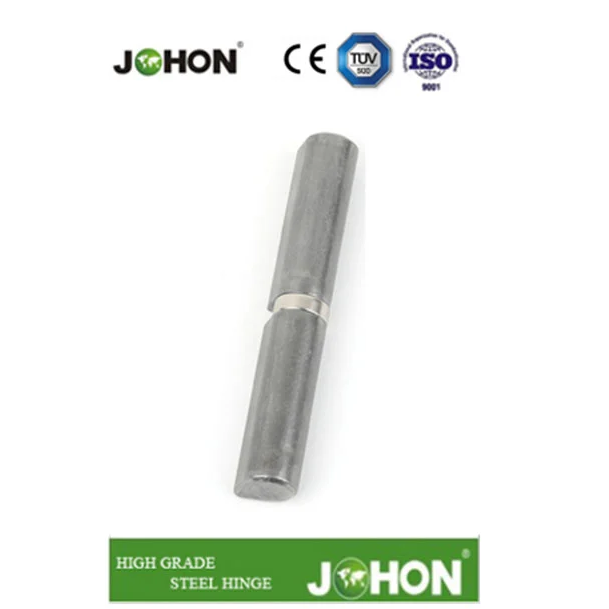
Quality weld on hinges fuse directly with the steel door. They bind securely into the metal frame. This fusion process creates a single, continuous load-bearing structure. The localized stress drops significantly compared to bolted plates. Weight distributes evenly across the entire metal grain. This structural continuity prevents sagging over decades of use.
Security tightens immediately when you eliminate mechanical fasteners. Weld integration makes the hardware impervious to standard removal tools. Intruders cannot simply unscrew a mounting plate. They would need heavy cutting equipment to breach the entryway. This makes welded assemblies standard for prisons and vault rooms.
Oversized steel access points generate massive rotational friction. Managing axial and radial loads becomes crucial here. Incorporating ball bearing welding hinges solves this heavy-duty problem. The internal bearings handle extreme downward pressure smoothly. They ensure fluid operation despite the massive door weight. This reduces strain on the automated opening mechanisms.
Welded configurations offer a surprisingly clean appearance. You achieve a completely flush finish. There are no protruding bolt heads to catch clothing. There are no bulky mounting plates disrupting the visual line. Proper grinding and painting seamlessly conceal the joints. This results in a highly professional industrial finish.
Bolted setups prioritize operational flexibility. Facilities managers often prefer this modular approach for standard commercial spaces. It allows for ongoing corrections without hot-work permits.
Commercial buildings settle over time. Frames shift due to seasonal temperature changes. Bolted connections offer a vital advantage here. You possess the ability to shim the backing plates. You can adjust and re-align doors post-installation. This ensures perfect latching despite environmental shifts. Welded doors lack this easy adaptability.
Hardware eventually wears out under heavy cyclic use. Bolted assemblies provide clear financial and logistical advantages. Replacing damaged components requires only standard hand tools. You do not need loud angle grinders. You avoid mandatory fire watches. You skip the repainting process entirely. Maintenance teams execute these swaps in minutes.
Bolting is ideal for specialized metal surfaces. It protects pre-finished, galvanized, or fire-rated steel doors perfectly. High heat application destroys protective coatings instantly. Welding often voids original manufacturer warranties. Bolted connections maintain these crucial surface treatments without compromise.
You must recognize mechanical fastener limits. Threaded bolts carry specific shear stress thresholds. High-frequency vibration causes bolts to back out slowly. Over time, heavy impacts shear the screw heads entirely. You must monitor these failure points closely. Regular inspection protocols are mandatory for bolted setups.
Comparing both methods reveals clear operational divides. Each style serves a distinct facility management philosophy. We break down the core differences below to simplify your engineering choice.
Evaluation Matrix: Application Features
Feature Category | Weld-On Configuration | Bolt-On Configuration |
|---|---|---|
Maximum Load Capacity | Superior. Ideal for heavy-gauge gates, vault doors, and blast-resistant applications. | Sufficient. Best for standard commercial hollow metal doors (typically up to 300 lbs). |
Installation Economics | Requires skilled certified welders, hot-work permits, and post-weld surface finishing. | Enables faster field assembly, requires standard hand tools, allows immediate deployment. |
Maintenance Philosophy | Run-to-failure model. Zero ongoing tensioning required. Requires cutting to replace. | Periodic tensioning model. Requires active inspection. Allows simple module replacement. |
Security Level | Maximum tamper resistance. No exposed mechanical weak points. | Moderate security. Fasteners can be targeted unless security studs are utilized. |
Welding dominates the ultra-heavy load categories. It is superior for heavy-gauge exterior gates. Vault doors rely entirely on welded continuity. Blast-resistant applications strictly demand fused metal. Conversely, bolting remains highly sufficient for standard commercial hollow metal doors. These standard doors typically weigh up to 300 lbs.
Installation methods dictate your labor requirements. Welding requires highly skilled labor. Certified welders command higher hourly rates. You must account for messy post-weld finishing. This includes grinding, priming, and painting. Bolting ensures much faster field assembly. Installation teams use standard drills and drivers. This allows for immediate door deployment.
Maintenance philosophies diverge sharply here. Welded setups follow a strict run-to-failure model. They require zero mechanical tensioning over their lifespan. Bolted setups demand an active maintenance schedule. Teams must perform periodic fastener tensioning. They replace stripped bolts promptly to prevent catastrophic door failure.
Theoretical planning meets harsh reality during installation. Both methods require strict mitigation strategies to succeed. You must anticipate common failure modes before they happen.
Managing warpage on thinner gauge steel doors poses a significant challenge. Intense heat warps light metal frames permanently. The industry actively debates correct welding techniques. Full-perimeter continuous welds maximize absolute strength. However, they also maximize hazardous heat input. Stitch or tack welding controls this heat effectively. Utilizing welding hinges using the stitch method often balances strength and structural integrity perfectly. Welders must alternate sides to let the metal cool.
Moisture enters through tiny mechanical gaps. Preventing rust at the thread-insertion points is mandatory. You must apply proper waterproof sealants. Thread-locking compounds prevent backing out and seal the threads simultaneously. Material matching prevents rapid galvanic corrosion. Never mix incompatible metals. Placing carbon steel bolts against stainless plates accelerates rust.
Misalignment destroys heavy hardware rapidly. Ensuring precise vertical alignment is critical. You must verify all door clearances prior to final torque. The same strict rule applies before the final weld pass. Proper spacing prevents premature bearing failure. Use spacer shims during the tacking phase to maintain the perfect gap. Removing binds ensures the door swings effortlessly.
Decision time requires clear operational parameters. We can simplify the selection logic for your engineering team. Follow these guidelines to determine the correct fabrication path.
You are fabricating custom heavy metal doors from scratch.
You require absolute maximum security against physical tampering.
You are installing hardware in a high-abuse industrial environment.
You are working directly with raw, unfinished carbon steel.
Your facility possesses easy access to certified welding professionals.
You are working with standardized commercial hollow metal frames.
You require strict ADA-compliant field adjustments over time.
You are installing on pre-painted or hot-dipped galvanized surfaces.
Your operational facility lacks the necessary hot-work permits.
You prioritize fast, modular replacement over extreme impact resistance.
You must audit your door’s exact physical weight. Document the expected daily cycle-rating requirements. Consult your local fire-door compliance codes if applicable. Fire codes dictate strict modification rules. Finally, match the hardware material to your specific environmental exposure. For example, choose carbon steel for dry interior warehouses. Select 316 stainless steel for demanding marine environments.
We avoid definitive claims about a universal "best" mounting option. The optimal choice depends entirely on specific project variables. It lies exactly at the intersection of load requirements, security needs, and maintenance capabilities. For heavy, static security, welding stands undefeated. It creates an impenetrable structural bond. For commercial adaptability, bolting provides unmatched maintenance convenience.
We encourage commercial buyers to prioritize proper alignment above all else. High-quality bearings matter immensely in heavy applications. Regardless of your chosen mounting style, excellent bearings ensure long-term functionality. Evaluate your environment carefully. Execute the installation precisely. Follow your chosen maintenance philosophy. Your steel door hardware will then deliver decades of reliable service.
A: Continuous full-perimeter welding provides maximum strength but introduces severe heat distortion risks. It often warps thinner gauge steel doors. In most applications, structural stitch welding or tack welding offers sufficient shear strength. Stitch welding minimizes heat input while securely anchoring the barrel to the frame.
A: Yes, but the replacement process is labor-intensive. It requires specialized tools. Maintenance teams must use angle grinders or plasma cutters to remove the failed component. They must grind the surface perfectly flat. Finally, they must weld the new unit in place and reapply protective paint.
A: The hinge barrel itself is typically identical in strength. The weakness exists entirely within the mechanical fasteners. Bolted setups rely on the shear strength of threaded bolts. Under extreme cyclic loading or heavy impact, these bolts can snap or loosen over time.
A: Bolt-on hardware is strictly preferred and often required. NFPA 80 compliance tightly regulates field modifications on fire-rated assemblies. Field-welding introduces unverified heat variables. It destroys protective intumescent seals and typically voids the manufacturer's fire-rating label entirely. Always consult fire codes before modifying these doors.
 English