Views: 0 Author: Site Editor Publish Time: 2026-06-26 Origin: Site
You stand at the hardware store checkout, staring at your basket. A sudden realization hits you. Hinge shape is not merely a minor aesthetic detail. It acts as a strict functional requirement for your doors. Choosing between square and round corners directly dictates your required installation tools. It also determines compatibility with existing door preparations. Making the wrong choice leads to frustrating structural mismatches. You might face sagging doors or damaged wood frames. We designed this guide to eliminate that guesswork entirely. You will receive a practical, evidence-based framework for choosing the correct hinge. We evaluate installation methods, architectural styles, and retrofit constraints. By the end, you will know exactly which hardware fits your specific project. You can skip the trial and error. You will approach your next door installation with absolute confidence and the right components in hand.
Existing Prep Rules All: When replacing hinges, matching the exact corner shape and radius of the existing door mortise is the only way to avoid structural patching and ensure proper load distribution.
Tool Dependency: Round hinges are designed for machine routing (speed and efficiency), whereas square hinges are traditionally installed via hand-chiseling.
Radius Variations Matter: Not all round corners are identical; distinguishing between a 1/4-inch and 5/8-inch radius is a mandatory step before purchasing.
Aesthetics Follow Function: While square hinges align with traditional or historic architecture, round variations dominate modern pre-hung doors due to manufacturing scale.
Door mortises refer to the shallow cutouts where hinges sit. Hardware must sit flush inside these cutouts. A flush fit ensures the door closes correctly without binding against the jamb. Woodworkers and door manufacturers create these mortises using specific tools. The tool chosen dictates the final shape of the cutout corners. You cannot separate the hinge shape from the woodworking tool used to install it.
Woodworking methods fall into two distinct categories. Each method leaves a completely different footprint on the door edge.
The Power Router Method: Power routers use spinning cylindrical bits to carve away wood rapidly. The bit moves along a guided template to create the mortise. Because the cutting bit is round, it naturally leaves rounded corners in the wood. A router cannot cut a sharp inside corner.
The Hand Chisel Method: Traditional carpenters use sharp metal hand chisels and mallets. A carpenter strikes the chisel to carve out the wood layer by layer. The flat blade of a chisel creates sharp, precise 90-degree square corners. This method demands more time and physical effort.
Hardware manufacturers adapted to these realities decades ago. They recognized carpenters wasted hours squaring off routed corners just to fit traditional hardware. To solve this, manufacturers began producing round hinges alongside square ones. They created specialized hardware specifically to accommodate modern power tools. This innovation eliminated the need for carpenters to alter a machine-routed mortise. Form directly followed function. Hardware adapted to tooling, permanently splitting the market into two standard shapes.
Today, pre-hung residential doors dominate the construction market. Manufacturers produce these doors in massive factories. High-volume commercial installations rely on speed and consistency. For these reasons, round corner hinges serve as the default standard. Automated CNC machines route thousands of door edges daily. Leaving the corners rounded saves critical manufacturing seconds per door. Over thousands of units, this translates to massive efficiency gains.
You must understand the radius factor before buying hardware. The radius defines the curve of the corner. Not all curves share the same measurements. The industry relies on two primary standards for residential and commercial doors. Buyers frequently overlook this detail. Purchasing the wrong radius means your hardware will not fit the existing mortise correctly.
Radius Size | Manufacturing Origin | Common Use Case | Visual Identifier |
|---|---|---|---|
1/4-Inch Radius | Cut using a smaller 1/2-inch router bit. | Custom doors, semi-custom builds, and specialized shop work. | A tight, slight curve. Almost looks square from a distance. |
5/8-Inch Radius | Cut using a massive 1 1/4-inch router bit. | Standardized mass-produced pre-hung doors found in major retail stores. | A broad, sweeping curve. Very distinctly rounded. |
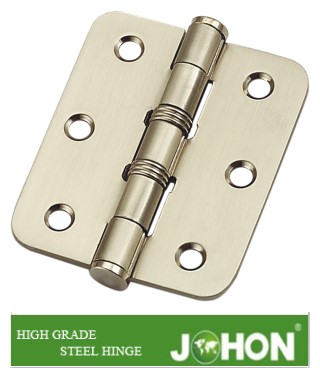
Many homeowners worry about durability when evaluating rounded designs. They assume softer edges imply weaker metal. This is functionally false. A steel round hinge provides the exact same structural integrity as a square equivalent. Load-bearing capacity depends on gauge thickness, metal quality, and bearing type. Corner shape has absolutely zero impact on how much weight the unit can hold. As long as you match the gauge and screw hole patterns, you sacrifice no strength by choosing the modern rounded standard.
Despite modern manufacturing shifts, square corners remain essential in specific scenarios. You will frequently encounter them during historic home renovations. Builders constructing solid wood custom doors often prefer them. Legacy architectural projects demand strict historical accuracy. In these environments, modern rounded hardware often looks out of place or historically inaccurate.
Architectural alignment drives the demand for sharp corners. Sharp 90-degree corners pair beautifully with specific architectural hinges. Designers often match them with traditional hardware finishes. Oil-rubbed bronze, distressed brass, and antique pewter look authentic on square plates. These sharp lines mirror the crisp millwork found in Victorian, Craftsman, or Colonial homes. When aiming for absolute historical fidelity, rounded corners break the visual immersion.
Choosing this traditional route increases your installation effort. Square mortises require precision hand-tooling. Even if a carpenter uses a router to remove the bulk of the wood, they must manually finish the job. They use a specialized corner chisel to stamp out the remaining rounded edges. A standard hammer and hand chisel work equally well. This manual intervention raises labor costs and slows down installation time. It requires a skilled hand to ensure the hardware sits perfectly flush without splintering the surrounding door casing.
Best practices dictate evaluating your budget before committing to traditional hardware. If you hire a professional, ask for labor estimates regarding manual mortise adjustments. The aesthetic payoff is high for custom projects. However, you must account for the extra hours required to achieve that perfect 90-degree fit.
Different projects require different decision frameworks. You must analyze your specific scenario before purchasing materials. We developed a straightforward decision matrix to guide your hardware selection. This chart outlines the easiest path forward based on your current door status.
Project Scenario | Primary Evaluation Rule | Recommended Hinge Shape |
|---|---|---|
Hardware Replacement | Never switch shapes unless modifying the door edge. | Match existing mortise exactly. |
Hanging a New Blank Slab | Assess your available toolset. | Round (if using router); Square (if using chisels). |
Design & Aesthetic Upgrades | Prioritize architectural consistency. | Shape matching interior design theme. |
The golden rule applies here. Do not switch shapes unless you plan to replace the entire door or frame. You must match the existing mortise perfectly. Start with a visual inspection process.
Open the door to a 90-degree angle.
Examine the existing metal plates set into the door edge.
Look closely at the corners. Are they sharp or curved?
If curved, take a measurement to identify the exact radius.
Purchase direct replacements matching these exact physical dimensions.
A blank door slab features no pre-cut holes or mortises. You control the preparation entirely. Evaluate your available tools to make your decision. If you own a standard hinge jig and a power router, default to rounded corners. The jig templates naturally produce a radius. It saves massive amounts of time. If you only own traditional hand tools, default to square corners. Hand carving a perfect radius is incredibly difficult and largely unnecessary. Let your toolkit decide the outcome.
Sometimes aesthetics override ease of installation. You might want to install high-end decorative door hinges to match specific interior design rules. For example, matching a square-rosette door lever requires square hardware. If your door currently features rounded mortises, you must perform structural modifications. You will need a specialized corner chisel tool. Place the tool into the rounded corner and strike it sharply. This cuts away the curved wood, leaving a crisp 90-degree pocket. Once squared, you can install your upgraded decorative hardware seamlessly.
Homeowners often try to force mismatched hardware into existing door preparations. This creates immediate problems. The "square peg in a round hole" scenario ruins door functionality and aesthetic appeal. Understanding these risks helps you avoid common DIY pitfalls.
Many view this as a harmless DIY shortcut. The hardware technically fits inside the cutout. However, it leaves a noticeable aesthetic gap in all four corners. Wood remains exposed around the curves of the metal. This looks highly unprofessional. Beyond aesthetics, it introduces a minor risk of moisture and debris accumulation. Dust settles into these small voids. Over time, in humid environments like bathrooms, moisture can penetrate the unsealed wood edges inside those gaps.
This presents a physical impossibility. A sharp corner cannot sit flush inside a curved pocket. The metal plate will protrude above the wood surface. If you force the screws down, you will bend the plate or strip the screw holes. The standard fix is mandatory. You must use a corner chisel to square out the routed radius before seating the new hardware. No shortcuts exist for this scenario. You must remove the conflicting wood.
Mismatched corners lead to improperly seated hardware. Improper seating creates severe structural risks. The metal must lay perfectly flat against the bottom of the mortise. It must transfer the weight of the door evenly into the jamb. When hardware protrudes or sits crooked, it alters the pivot axis. The door will bind against the frame. It will begin to sag under its own weight. Eventually, the unequal tension will pull the screws entirely out of the wooden jamb. You will ruin the door frame structure.
Hinge shape clearly extends far beyond visual preferences. Neither profile is inherently better in terms of pure strength, durability, or mechanical function. Superiority depends entirely on your door's current preparation and your available toolkit. Modern factory doors demand curved corners for rapid router assembly. Traditional historic builds rely on sharp 90-degree lines for authentic craftsmanship.
Your path forward is simple. First, measure your existing hardware radius using the visual inspection methods discussed. Next, verify the specific tools you plan to use for the installation. Finally, proceed confidently to your hardware supplier with exact specifications in hand. By respecting the existing door preparation, you ensure a flush fit, perfect load distribution, and a professional-grade installation every single time.
A: Use the simple "coin trick" at home. Line up a dime inside the corner of the hinge plate. If it fits perfectly, you have a 1/4-inch radius. Line up a quarter inside the corner. If it traces the curve nicely, you have a 5/8-inch radius. You can also use a standard tape measure from the start of the curve to the imaginary square point.
A: No. Shape does not dictate strength or durability. Overall load capacity depends entirely on metal gauge thickness, material composition, and bearing type. A solid steel plate with curved edges holds the exact same weight as a square plate of identical thickness.
A: We strongly advise against this practice. Mixing shapes looks highly unprofessional and disrupts architectural consistency. It also complicates your installation process by requiring two different sets of tools. Mixing profiles offers absolutely zero structural benefit to the door assembly.
 English