Views: 0 Author: Site Editor Publish Time: 2026-10-14 Origin: Site
Choosing hardware for specialty doors often seems straightforward until you mistakenly order the incorrect handing. Procuring the wrong handing for specialty door hardware results in costly project delays, immediate returns, and compromised structural integrity. Unlike standard reversible butt hinges, lift off hinges feature a fixed pin on only one leaf. Installing them incorrectly or upside down voids load-bearing capacities and causes immediate mechanical failure.
This guide provides a standardized, fail-proof framework for facility managers, builders, and procurement teams. We aim to help you accurately identify and specify the precise handing for your commercial or residential doors. You will learn the visual pin-up rule to verify loose hardware in seconds. We will also explore how to assess load dynamics, specify materials, and navigate common installation pitfalls. By mastering these principles, you prevent budget overruns and keep your construction timelines firmly on track.
Handing is dictated by the location of the hinges when facing the pull side of the door.
A physical visual test (the "Pin-Up" rule) can identify the handing of a loose hinge in seconds.
Selecting the correct hinge requires evaluating vertical clearance, load limits, and material (e.g., specifying a steel lift-off hinge for heavy-duty applications).
Misidentifying handing is the leading cause of installation failure for removable door systems.
To understand why proper handing matters, we must first look at the physical mechanics of removable door hardware. A conventional butt hinge distributes weight across interwoven knuckles using a removable central pin. Removable door systems operate on a completely different structural paradigm. They rely on gravity and strict orientation to maintain their physical integrity.
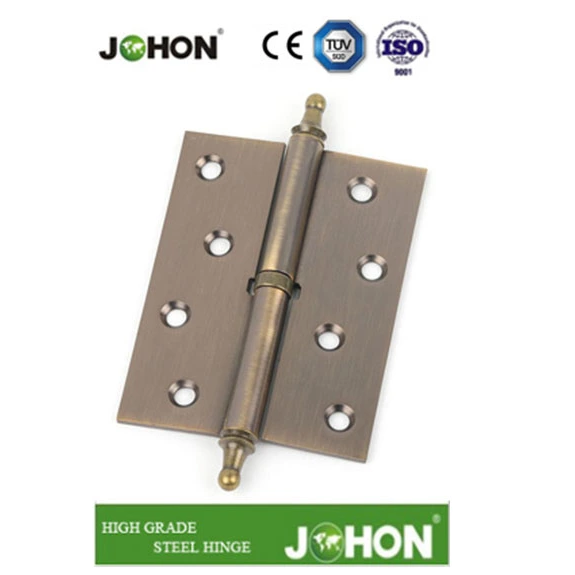
Removable assemblies consist of two distinct halves: a male leaf containing a permanently attached vertical pin, and a female leaf featuring a hollow barrel. The male leaf must always attach to the stationary door frame. Furthermore, it must sit at the bottom of the hinge joint. The female leaf attaches to the swinging door panel and slides downward onto the fixed pin.
Gravity keeps the door securely seated. If you order the wrong handing and attempt to flip the hinge upside down to make it fit, the male pin points downward. The door will immediately slip off the pin upon installation. You cannot force a left-hand component to perform a right-hand job without defying gravity.
Building codes and fire safety regulations leave no room for compromised hardware. Attempting to invert a mismatched hinge compromises fire-rating compliance. Fire doors require exact closing forces and structural stability to contain smoke and flames. Hardware installed upside down cannot maintain the necessary shear strength under extreme heat. Over time, improper weight distribution accelerates metal fatigue. The hinge sags, the door binds against the frame, and the entire assembly becomes a severe safety hazard during emergency evacuations.
Mistakes in hardware specification carry heavy financial penalties. Incorrect orders trigger immediate downtime on the job site. Carpenters and installers sit idle while project managers scramble to source replacements. You face return shipping costs, restocking fees, and delayed occupancy permits. In commercial builds, missing an occupancy deadline often triggers contractual penalties. Accurately identifying your hardware handing upfront protects your budget and your professional reputation.
Determining the correct orientation does not require complex engineering formulas. Industry professionals rely on a proven, two-step framework. You can evaluate the door frame before ordering, or you can evaluate the hardware directly if you hold a loose part.
The most reliable way to determine your required handing is by looking at the physical opening. You must establish the correct perspective before making any decisions.
Establish Perspective: Stand facing the door on the side where the door pulls toward you. This is universally known as the "pull side" or the "secure side." Do not stand on the push side, as this reverses the entire logic.
Locate the Hinge Side: Look at where the hinges connect to the frame.
Apply the Rule: If the hinges sit on your left, you require a left-hand hinge. If the hinges sit on your right, you require a right-hand hinge.
This simple visual test works for standard single doors across both residential and commercial applications. Remember to always evaluate the pull side.
Sometimes you need to replace an existing component, or you find loose hardware in a warehouse bin. The "Hinge-in-Hand" test allows you to identify the handing without seeing the door.
Orientation: Open the hinge completely flat like a book. Face the countersunk screw holes toward you. These holes must face outward so the screw heads sit flush.
The Pin Rule: Look closely at the permanently fixed pin.
Identify Right-Hand: If the pin points UP on the right leaf, it is a right-hand hinge.
Identify Left-Hand: If the pin points UP on the left leaf, it is a left-hand hinge.
If the pin points downward during your evaluation, flip the entire assembly right-side up and apply the rule again. The pin must always point toward the ceiling.
Identifying left or right orientation solves only half the procurement puzzle. You must also align the hardware specifications with your environmental conditions and structural demands. A mismatch in material or load capacity leads to premature failure just as quickly as a handing error.
Your operating environment dictates the required metal. For high-traffic commercial corridors or heavy solid-core doors, you should specify a steel lift-off hinge. Solid steel provides exceptional shear strength and resists warping under constant cyclic loading.
Conversely, exterior gates, marine applications, or washrooms demand corrosion resistance. Stainless steel offers excellent rust prevention. Brass provides a decorative finish for high-end residential interiors but supports significantly less weight than steel. Always verify the metal type against local environmental conditions before issuing a purchase order.
The architectural geometry of your application influences the hinge shape. Standard offset designs push the pivot point away from the frame, allowing doors to swing clear of trim. However, industrial enclosures, custom cabinets, and specialized gates often require a flatter profile.
In these scenarios, a removable H door hinge provides a robust alternative. Shaped like the letter "H," this design mounts flat against the surface. It eliminates the need for deep mortising. This makes it highly popular for electrical cabinets and access panels requiring rapid removal.
Never guess the weight capacity of your hardware. Maximum weight capacity relies on three physical factors: leaf thickness, overall leaf height, and bearing type. Thicker leaves prevent the metal from tearing under torque. Taller leaves distribute weight over a larger vertical footprint.
Standard friction joints handle lightweight hollow-core doors easily. However, heavy commercial doors require ball-bearing variants. Ball bearings reduce friction between the male and female leaves. This ensures smooth operation and prevents the metal from grinding down over time.
Hardware Specification Comparison Matrix
Hinge Material / Type | Ideal Environment | Load Capacity Profile | Common Applications |
|---|---|---|---|
Solid Steel | Dry, indoor commercial | High (Heavy-Duty) | Warehouse doors, fire doors, high-traffic corridors |
Stainless Steel | Corrosive, damp, exterior | Medium to High | Marine environments, commercial kitchens, exterior gates |
Brass | Dry, decorative residential | Low to Medium | Interior residential doors, custom cabinetry |
H-Shape Profile | Industrial enclosures | Medium (Surface Mount) | Electrical cabinets, access panels, heavy storage boxes |
Even perfectly specified hardware fails if the installation ignores physical realities. Facility managers and carpenters must anticipate structural conflicts before drilling the first hole. Removable doors demand higher precision during installation than standard pinned joints.
The most common engineering oversight involves vertical clearance. To remove a door, you must physically lift it straight up until the female barrel clears the male pin. This action requires adequate space between the top of the door and the ceiling or header.
If you fail to leave adequate space above the door frame, you cannot remove the door. The entire purpose of the hardware becomes useless. Always measure the pin length. Add at least a half-inch of extra clearance to your ceiling measurements to guarantee easy removal.
Microscopic misalignments during installation cause the pins to bind. If the top and bottom hinges do not share a perfectly plumb vertical axis, the door swings at an angle. This puts immense lateral pressure on the fixed pins. Over time, this friction causes the female barrel to seize onto the male pin. When binding occurs, lifting the door becomes impossible without causing permanent damage to the frame.
Use a laser level to establish a perfectly plumb vertical line across all hinge mortises.
Rout mortises to a consistent depth. Uneven depths tilt the leaves and strain the pins.
Apply a small amount of graphite lubricant to the pins prior to final hanging.
Removable hardware presents unique security challenges, particularly on exterior out-swing doors. When a door swings outward, the hinges sit on the exterior side of the building. An intruder can simply open the door slightly and lift it off the frame.
To mitigate this risk, you must specify security stud variants for vulnerable perimeters. These versions feature an interlocking stud that engages when the door is closed. Even if someone removes the conventional pins, the security stud holds the door firmly inside the frame.
Your hardware performs only as well as the manufacturer behind it. Selecting the right vendor minimizes long-term maintenance headaches and guarantees dimensional accuracy.
Precision machining dictates the lifespan of a removable assembly. You must demand high tolerance standards from your vendors. If the gap between the male pin and the female barrel is too wide, the door rattles and sags. If the tolerance is too tight, the metals seize during temperature fluctuations. Reputable manufacturers machine their parts to tight, predictable tolerances to ensure a perfect glide during removal and replacement.
Never issue a purchase order without reviewing the manufacturer's technical documentation. Insist on technical spec sheets that clearly denote handing diagrams. Some international manufacturers utilize reversed handing conventions based on local standards. Cross-referencing their visual diagrams against the "Pin-Up" rule eliminates ordering errors. Additionally, robust commercial warranties protect your investment against premature metal fatigue and bearing failure.
Procuring identical footprint hardware across an entire facility yields massive dividends. When you standardize your hinge dimensions, maintenance teams can swap out damaged doors in minutes without routing new mortises. It streamlines inventory management, reduces training time, and minimizes emergency procurement delays. Choose a vendor capable of supplying large volumes of consistent, dimensionally identical hardware over a multi-year timeframe.
Accurately identifying and specifying removable hardware prevents catastrophic delays and protects structural integrity. As we have explored, identifying the correct handing relies on a strict, rule-based approach. You must either stand facing the pull side of the door or apply the visual pin-up test to loose hardware. There is no room for guesswork.
Before moving forward, always double-check your vertical frame clearances and calculate exact load requirements. Select appropriate materials based on environmental exposure, and prioritize vendors who deliver precision tolerances. By applying this systematic framework, you guarantee seamless installations, optimal door performance, and a safer built environment.
A: No. Because the pin is permanently fixed to one half of the hinge and must point upward to support the door, they cannot be flipped over. Inverting them causes the pin to point down, resulting in immediate failure.
A: Hardware handing rules can shift based on reverse-bevel doors, but the core rule of thumb for procurement is matching the hinge pin orientation to the physical frame requirement. Always consult the manufacturer's specific handing chart to verify reverse-bevel applications.
A: Measure the overall height of the leaf, the total width when the hinge is laid completely flat, and the exact screw hole pattern. Precise measurements ensure a direct replacement without requiring you to rout new mortises or drill new pilot holes.
 English