Views: 0 Author: Site Editor Publish Time: 2026-07-21 Origin: Site
Getting a door to swing smoothly requires more than just picking hardware off a shelf. You rely on precision engineering to keep daily entryways functional, safe, and secure. The margin for error during installation remains incredibly slim. Undersizing a hinge leads directly to annoying door sag. It also causes permanent frame damage and inevitable building compliance failures. Conversely, oversizing wastes valuable project resources. It unnecessarily complicates the mortise routing process for installers. Understanding proper hardware dimensions prevents these costly structural failures before they happen.
This guide moves past generalized advice. We offer a strict, specification-driven framework for selecting entry hardware. You will learn how to evaluate door weight, width, and traffic frequency correctly. Facility managers, commercial contractors, and homeowners upgrading custom doors will find this information essential. You can use these exact metrics to specify architectural hardware confidently.
Door dimensions dictate the baseline: Door thickness and width are the primary mathematical drivers for hinge height and width.
Weight thresholds: 4-inch hinges support standard commercial doors (up to ~150 lbs), while 5-inch hinges are engineered for heavy, oversized, or high-traffic doors.
Material multipliers: Hinge size is only half the equation; upgrading to steel butt hinges or ball-bearing configurations drastically alters the load capacity of either size.
Retrofit constraints: Upgrading from 4-inch to 5-inch hinges requires frame modification (mortise routing), making upfront accurate specification critical.
Hinge failure rarely occurs due to a manufacturing defect. It almost always stems from a specification error regarding load distribution. When door hardware fails, installers often blame the material. Realistically, improper sizing causes uneven stress across the door jamb. You must calculate mechanical load correctly from the start. Calculating proper butt hinge size requires precise measurements rather than guesswork.
Many contractors rely on outdated rules of thumb. Engineering reality demands a stricter approach. Door thickness acts as your first major constraint. Standard 1-3/4” thick doors generally require at least a 4-inch or 4.5-inch height. Upgrading to 2” or 2-1/2” doors pushes the absolute requirement to 5 inches. The physical mass of thicker doors mandates a taller knuckle to distribute weight evenly.
Door width also alters the physical leverage acting on the frame. Doors up to 36” wide typically align well with 4-inch hardware. However, doors over 36” introduce severe leverage forces. This added horizontal torque necessitates a 5-inch height. A wider door creates a longer lever arm. This lever pulls forcefully against the top mounting screws.
Clearance calculations ensure the door swings fully without binding against the trim. You cannot simply guess the required width. A standard mathematical formula prevents trim interference.
Measure the total door thickness accurately.
Add the frame backing dimension (the distance from the door edge to the frame face).
Add the required clearance for any projecting casing or trim.
Calculate the sum to find your minimum hinge width.
Using this formula guarantees smooth operation up to 180 degrees. It keeps the knuckle protruding just far enough to clear the casing.
The industry relies heavily on standardized hardware for everyday construction. Builders frequently specify 4 inch butt hinges for typical interior commercial projects. These units serve as the workhorse for standard 1-3/4" commercial hollow metal doors. You will also find them on solid wood interior doors in offices. They perfectly fit standard retail entryways and premium residential doors.
Load capacity dictates their operational limits. A standard 4-inch setup typically supports up to 150 lbs. This rating assumes standard frequency usage and a plain bearing configuration. Pushing past this weight limit causes premature wear. The knuckles grind together under excessive vertical loads. Facility teams must strictly monitor the weight of custom wood doors. Adding heavy veneers or acoustic panels often pushes a standard door past 150 lbs.
Cost and availability make this size highly attractive. Manufacturers produce these standard units in massive volumes. This standardization allows for easy replacement. Broad hardware compatibility means maintenance teams can swap out damaged units quickly. You rarely face long lead times for replacements. Frame manufacturers pre-punch standard hollow metal frames to accept this exact footprint.
However, implementation risks exist. Using this standard size on high-traffic exterior doors causes problems. Exterior wind loads and constant cycling create severe stress. Over time, you will notice premature pin wear. Lateral sagging soon follows. This sagging causes the door to drag across the threshold. Eventually, the locking mechanism fails to latch properly. You must match the hardware rating strictly to the environmental demands.
Certain architectural designs push building materials to their physical limits. Recognizing the specific upgrade triggers prevents catastrophic hardware failure. You must upgrade to 5 inch butt hinges under specific, measurable conditions.
The door weight exceeds the 150–200 lbs threshold. Lead-lined hospital doors, oversized acoustic studio doors, and custom solid hardwoods fall into this category.
The door width exceeds 3 feet. Extra width drastically increases horizontal torque on the top mounting points.
The location experiences high-frequency usage. School entrances and busy hospital corridors endure abusive traffic daily.
Upgrading provides significant long-term maintenance benefits. Heavy hardware reduces ongoing maintenance overhead. It prevents the door frame from tearing out under stress. A frame tear-out in a commercial environment requires expensive drywall repair and fresh paint. Installing the correct hardware initially eliminates these subsequent repairs. The added bearing surface handles extreme abuse effectively.
Installation considerations require careful planning during the framing stage. Larger hardware requires much deeper, wider mortises in the door edge. The jamb also needs larger cutouts. You cannot simply screw these into standard wood framing. They often require heavier gauge mounting screws. You must provide reinforced frame backing. Commercial metal frames need factory-welded reinforcement plates. Wood frames require structural blocking behind the jamb to anchor the longer screws securely.
Dimension acts as only one variable in the mechanical equation. The underlying metal type drastically alters performance and longevity. You must align the material chemistry with the environmental hazards of the building.
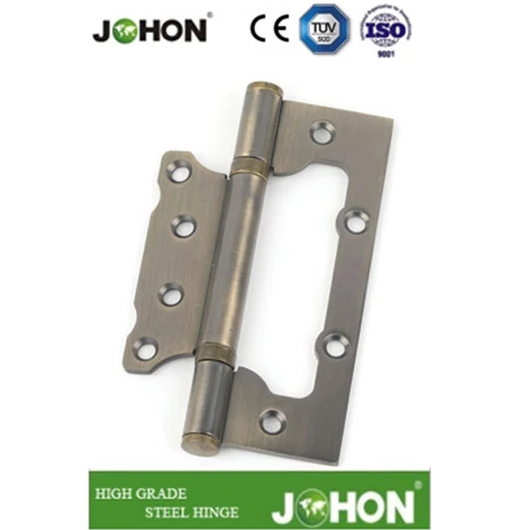
Specifying steel butt hinges sets the baseline for high strength. Steel provides exceptional fire ratings required by commercial building codes. It resists deformation under extreme weight. However, standard steel remains highly susceptible to rust. Exterior doors or corrosive industrial environments will degrade raw steel quickly. You must use steel strictly in climate-controlled interior corridors.
Brass and bronze offer aesthetic appeal and natural corrosion resistance. However, they possess a much lower tensile strength than steel. These softer metals bend under high stress. You become heavily reliant on stepping up a size if using brass on heavier doors. A 4-inch brass unit will fail where a 4-inch steel unit succeeds.
Stainless steel provides the optimal balance. It excels in exterior applications and sterile medical environments. Stainless steel maintains immense tensile strength without yielding to corrosion.
Internal mechanics matter just as much as the external material. You must choose between plain bearing and ball bearing configurations. Plain bearings feature metal-on-metal contact. They work adequately for lightweight, low-use residential doors. However, you must specify heavy duty butt hinges equipped with ball bearings under certain conditions. Any door equipped a mechanical door closer absolutely requires ball bearings. The closer exerts constant downward and lateral pressure during operation. Ball bearings absorb this extra stress smoothly. They prevent the knuckles from grinding down over time, regardless of whether you use a 4-inch or 5-inch size.
Contractors often fall into the retrofit trap during renovation projects. Upgrading hardware is rarely a simple swap. You cannot simply remove a 4-inch hinge and replace it with a 5-inch version. The height and depth differences require extensive re-routing. Installers must cut a larger mortise into the door edge. They must also expand the pocket on the jamb. Doing this accurately on an already hanging door proves incredibly difficult. This retrofit reality makes upfront specification vital.
Corner radius compatibility trips up many residential upgrades. Pre-routed residential doors typically feature either 1/4" or 5/8" radius corners. Installers use routers to cut these pockets quickly. Commercial standards universally rely on square corners for maximum surface contact. Trying to force a square corner hinge into a radiused mortise requires manual chiseling. Failing to match the corner radius ruins the aesthetic and creates weak mounting points.
Fastener failures ruin even the most robust hardware setups. A massive 5-inch unit will fail exactly like a flimsy 3-inch unit if installed poorly. Inadequate screws pull right out of the frame. You must specify exact thread types and lengths based on the frame material.
Frame Material | Required Fastener Type | Minimum Penetration |
|---|---|---|
Solid Wood Jambs | Coarse Thread Wood Screws | At least 1-1/2 inches into the stud |
Hollow Metal Frames | Machine Screws (Self-Tapping or Pre-Threaded) | Fully seated into reinforced backing plates |
Wood Doors (Solid Core) | Standard Wood Screws | 1-1/4 inches depending on door thickness |
Wood frames demand long, coarse-thread screws to bite into the structural stud behind the jamb. Metal frames require precise machine screws. Never use wood screws in a metal frame, or vice versa. Proper fastening ensures the hardware achieves its rated load capacity.
Making the correct specification requires matching hardware geometry to physical demands. Following a strict decision matrix removes the guesswork from your next project.
Choose the 4-inch height for standard 1-3/4" doors. This applies when the width remains under 36" and the weight stays below 150 lbs.
Choose the 5-inch height for wider, heavier applications. You need this size for doors over 36" wide or thicker than 2". It also handles any setup weighing over 150 lbs or enduring abusive daily traffic.
Before finalizing any purchase order, take immediate physical action on the job site. Audit the specific door weight using the manufacturer's data sheet. Measure the exact door thickness with calipers. Verify the frame material to ensure you order the correct fasteners. Taking these steps guarantees a secure, long-lasting installation.
A: The number of hinges depends entirely on the door height, not the hinge width or height. Industry standards dictate installing one hinge per 30 inches of door height. A standard 7-foot door requires three hinges. A door reaching 8 feet or taller needs four hinges to prevent warping.
A: Sometimes. Upgrading to a heavy-gauge, ball-bearing 4-inch unit increases the vertical load capacity significantly. However, it does not increase the physical height leveraging. If your door is over 36 inches wide, the horizontal torque still demands the taller 5-inch leaf to distribute forces properly across the jamb.
A: Yes, the 4.5" x 4.5" specification serves as the actual midpoint for many commercial B2B applications. It provides extra bearing surface and load distribution over a 4-inch unit without requiring the massive frame reinforcements of a true 5-inch installation. It handles standard commercial steel doors perfectly.
 English