Views: 0 Author: Site Editor Publish Time: 2026-08-22 Origin: Site
Have you ever noticed a heavy commercial door dragging against its frame or failing to latch securely? Specifying the wrong hardware causes severe operational and financial headaches. Doors inevitably sag. Moving parts wear out prematurely. Building owners often face severe security vulnerabilities or fail rigorous fire compliance inspections. Replacing a damaged door frame disrupts daily operations and wastes valuable time.
A successful hardware selection requires a strict balance. You must carefully balance load-bearing capacity, environmental resilience, and architectural aesthetics. When you get this right, doors operate flawlessly for decades without needing constant adjustments. We designed this guide to help you evaluate these options with confidence.
We provide a strict, evidence-based framework for evaluating and selecting the correct hardware specifications. You will learn the exact mechanical principles behind a butt hinge. By the end of this guide, you will know exactly how to match hardware to your residential, commercial, or industrial applications.
Standard plain-bearing hinges are limited to lightweight, low-traffic applications; high-traffic doors require ball bearing butt hinges.
Door weight, door width, and frequency of use are the non-negotiable variables when calculating hinge size and quantity.
Heavy duty butt hinges are mandatory for industrial applications or oversized doors to prevent premature failure.
Material selection (e.g., 316 Stainless Steel vs. Brass) dictates environmental suitability and maintenance lifecycles, not just aesthetics.
To choose the right hardware, you must first understand how it distributes physical weight. Every unit relies on a specific set of components working together to manage complex physical forces.
You can break down the anatomy into four essential parts. Each part plays a critical role in overall door stability.
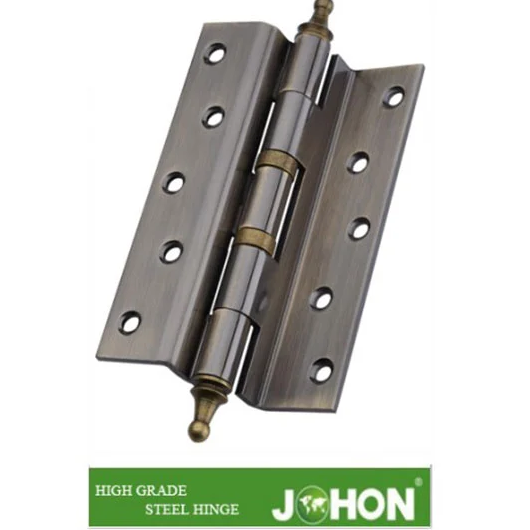
The Leaves: These are the flat metal plates. One leaf attaches to the door frame, while the other attaches to the door edge. They act as the primary anchors.
The Knuckle: This is the central cylindrical loop formed where the two leaves meet. It houses the internal mechanisms.
The Pin: A solid metal rod slides directly down through the knuckle. It holds the leaves together and acts as the pivot axis.
The Bearings: Located between the knuckle joints, these small components reduce metal-on-metal friction during movement.
When you open a door, it exerts two distinct forces. Thrust load represents the downward vertical weight of the door. Radial load represents the horizontal pull pulling away from the frame. Mortised installation plays a crucial role in managing these forces. Installers carve a shallow recess into the door and frame. By embedding the leaves into these recesses, the mortise transfers shear stress directly into the solid wood or metal frame. The hardware no longer relies solely on the mounting screws to hold the weight.
Low-quality components fail predictably under stress. You will often notice a fine black metal dust accumulating around the hinges. This dust results from knuckle grinding. When thrust loads exceed capacity, the knuckles grind against each other, shaving off microscopic metal particles. Additionally, extreme radial loads can cause pin bending. If a door is too wide for its hardware, the leverage bends the internal pin. This misalignment prevents the door from closing flush. Recognizing these failure points explains why upgrading to specific bearing types is often necessary.
You must match the internal bearing mechanism to your specific traffic volume. Choosing a basic residential model for a busy office building guarantees a quick hardware failure.
These are the most basic models available. They do not contain any specialized friction-reducing bearings between the knuckles.
Best for: Lightweight, low-traffic interior residential doors. They work perfectly for hollow-core bedroom or closet doors.
Limitations: They are highly prone to squeaking. Under heavy loads, they experience rapid metal dust accumulation over time. You should never use them on exterior doors or doors equipped with automatic closers.
These units insert small, lubricated steel ball bearings between the knuckle joints. This design separates the knuckles, preventing direct friction.
Best for: Medium-to-heavy doors, commercial entryways, and doors with closers.
Value Proposition: They offer permanently lubricated bearings that drastically reduce friction. This eliminates sagging and dramatically extends the operational lifespan of the door. If you manage an office, ball bearing butt hinges are the baseline standard.
Industrial environments demand reinforced hardware. These units handle extreme weights and constant abuse.
Best for: Industrial gates, lead-lined doors, vault doors, and extreme high-frequency environments like schools or hospitals.
Differentiator: They feature a much thicker leaf gauge, often measuring .180" or .190" in thickness. They also utilize larger pins and feature heavy-grade steel or stainless steel construction. Using heavy duty butt hinges prevents catastrophic failure in oversized applications.
Some projects require unique functionality beyond simple pivoting. You can find specialty configurations tailored to specific architectural needs.
Spring-loaded: These self-closing units contain internal coiled springs. They automatically pull the door shut behind you.
Rising Butt: These feature a spiral knuckle joint. As you open the door, the hinges lift the door upward slightly. This clears thick carpets or uneven flooring.
Security: Used on out-swinging exterior doors, these feature non-removable pins. Burglars cannot tap the pin out to remove the door from its frame.
Material selection dictates environmental suitability and maintenance lifecycles, not just aesthetics. Using the wrong metal in a corrosive environment leads to rapid structural decay.
Stainless steel offers exceptional durability and natural rust resistance. However, you must choose the correct grade for your environment.
Grade 304 handles most interior and mild exterior commercial applications well. It resists basic moisture effectively. However, Grade 316 provides superior corrosion resistance due to added molybdenum. Grade 316 is strictly required for marine environments, chemical processing plants, or severe exterior environments subject to road salt. If you install 304 near the ocean, it will still rust.
Brass provides exceptional aesthetic superiority and complete natural rust resistance. Water simply cannot cause brass to rust. This makes it highly desirable for high-end residential exteriors or luxury commercial spaces.
However, you must account for its composition. Brass is a soft metal. It bends and deforms much easier than steel. If you use brass on heavy solid-core doors, you must specify significantly thicker gauges to prevent the leaves from warping under the thrust load.
Steel delivers the highest structural strength and remains highly cost-effective. Builders prefer steel for massive doors where budget and load capacity intersect.
The drawback is corrosion. Steel is highly susceptible to rust unless it is properly plated, galvanized, or treated. You should reserve standard steel models strictly for interior spaces or highly climate-controlled commercial use. If exposed to rain, unprotected steel seizes up entirely.
Commercial fire-rated doors operate under strict legal mandates. You cannot simply choose hardware based on looks. Building codes often legally mandate specific steel or stainless steel models.
In the event of a fire, brass and aluminum melt at much lower temperatures than steel. To maintain the integrity of a fire barrier, you must look for certifications like ANSI/BHMA. Hardware lacking these explicit fire ratings will cause the entire doorway to fail its compliance inspection.
Guessing your hardware dimensions leads to bind, sag, and failure. You must rely on concrete mathematical formulas to determine height, width, and quantity. Properly sized butt hinges distribute weight evenly across the entire frame.
Industry standards provide a clear baseline for height based on the thickness and weight of the door. The taller the leaf, the more surface area it covers, which increases load capacity.
Doors up to 1-3/8" thick typically require 3.5" tall hinges.
Doors measuring 1-3/4" thick generally require 4.5" tall hinges.
Doors exceeding 2" in thickness or 40" in width usually require 5" or larger models.
Standard Door Hardware Sizing Chart
Door Thickness | Door Width | Recommended Height |
|---|---|---|
1-3/8 inches | Up to 32 inches | 3.5 inches |
1-3/4 inches | Up to 36 inches | 4.5 inches |
1-3/4 inches | 36 to 48 inches | 5.0 inches |
Over 2 inches | Over 40 inches | Heavy Duty 5.0+ inches |
Width dictates how far the door swings away from the frame. If you get this wrong, the door will bind against the trim when opened 180 degrees.
You can calculate the required width using a simple formula based on door thickness, backset, and required clearance to prevent frame binding. Add the door thickness to the required clearance (the thickness of your decorative trim). Then, multiply the backset (the unmortised distance from the edge of the door) by two and subtract it from the total. This final number ensures your knuckles sit far enough past the casing to allow a full swing.
Never under-support a door. Most installers follow the strict "one hinge per 30 inches of door height" standard rule.
Doors up to 60 inches tall require two units.
Doors between 60 and 90 inches tall require three units.
Doors between 90 and 120 inches tall require four units.
Adding an extra unit helps distribute the radial load, preventing the top hardware from bearing the entire horizontal pulling force.
Raw weight only tells half the story. You must address how wide doors create greater leverage. In physics, this is called the moment arm. A 100-pound door that is 48 inches wide exerts significantly more pulling force on the top frame than a 100-pound door that is only 30 inches wide.
Wide doors create greater leverage, requiring either taller heights, thicker gauges, or heavy-duty ratings regardless of raw weight. If you ignore the moment arm, the upper screws will eventually strip out of the wood.
Even the finest hardware fails if you install it poorly. Proper execution requires tight tolerances and specialized tools. Watch out for these common installation pitfalls.
Routing depth must perfectly match the leaf thickness. If you cut the mortise too deep, the leaves pull the door too close to the jamb. This creates hinge-bind, where the door pinches the frame and springs open. If you cut the mortise too shallow, the leaves protrude. This creates uneven, unsightly gaps and prevents the latch from engaging the strike plate properly. Installers should always use sharp router templates to ensure micrometer-level accuracy.
Heavy doors generate intense shear forces. You must discuss the importance of adequate screw length. A common mistake involves using the short 1-inch screws included in the box. These short screws only bite into the soft wooden door jamb. Over time, the weight rips them right out.
For large doors, especially those utilizing thick steel components, your screws must penetrate the actual framing studs located behind the jamb. Using 3-inch or 4-inch screws on the frame-side leaf provides incredible structural rigidity.
A non-plumb frame ruins hardware. If the door frame leans even a fraction of an inch, the pivot points fall out of alignment. This forces one knuckle to bear the weight of the entire door, causing uneven bearing wear. Extreme misalignment literally grinds the internal bearings to dust in a matter of months. Furthermore, manufacturers routinely void warranties if they discover you installed their products on a severely misaligned frame. Always check your jambs with a large level before hanging.
Selecting the right hardware does not have to be a guessing game. By applying a structured framework, you ensure long-lasting performance and eliminate costly repairs.
Always follow a linear decision path. First, weigh the load and traffic frequency. This tells you if you need plain bearings, lubricated balls, or extra-thick heavy-duty gauges. Second, determine the best material for the environment. Use steel for interior strength, brass for aesthetics, and 316 stainless for corrosive coastal conditions. Finally, select the proper size based on clearance formulas and the 30-inch quantity rule.
If you manage large-scale projects, do not risk compliance failures. We highly encourage consulting with a commercial hardware specialist for fire-rated, industrial, or complex architectural projects. A professional can help you verify ANSI/BHMA compliance before purchase, ensuring your building meets all local fire and safety codes.
A: Plain bearings feature knuckles that rub directly against each other, creating metal-on-metal friction. This limits them to lightweight, low-traffic doors. Ball bearing models contain lubricated steel balls between the knuckles. This drastically reduces friction, eliminates squeaking, prevents sagging, and vastly extends the lifespan of heavy or high-traffic doors.
A: You need them if your door exceeds standard thresholds for weight, door width, or usage frequency. Generally, doors over 150 pounds, doors wider than 36 inches, or entrances in high-frequency environments like schools and hospitals require heavy-duty gauges (.180" or thicker) to prevent structural failure.
A: Yes, if the specifications match perfectly. You must verify that the new leaf thickness matches your existing mortise depth. Additionally, you must check the corner radius. Hardware typically features square corners, 1/4" radius, or 5/8" radius corners. If the radii match, you can easily swap them without cutting.
A: Most standard architectural models are completely non-handed, meaning you can flip them upside down for either left or right-hand doors without issue. However, some specialty variants, like specific rising butt hinges or certain spring-loaded models, possess strict handing requirements and cannot be reversed.
 English